Real LEGO Minifigure or Not? How to Identify the Original
Not every figure that is not LEGO is a fake. How to tell an original, a rival brand, a custom and an actual counterfeit apart — and where the maker's name is moulded into every genuine part.
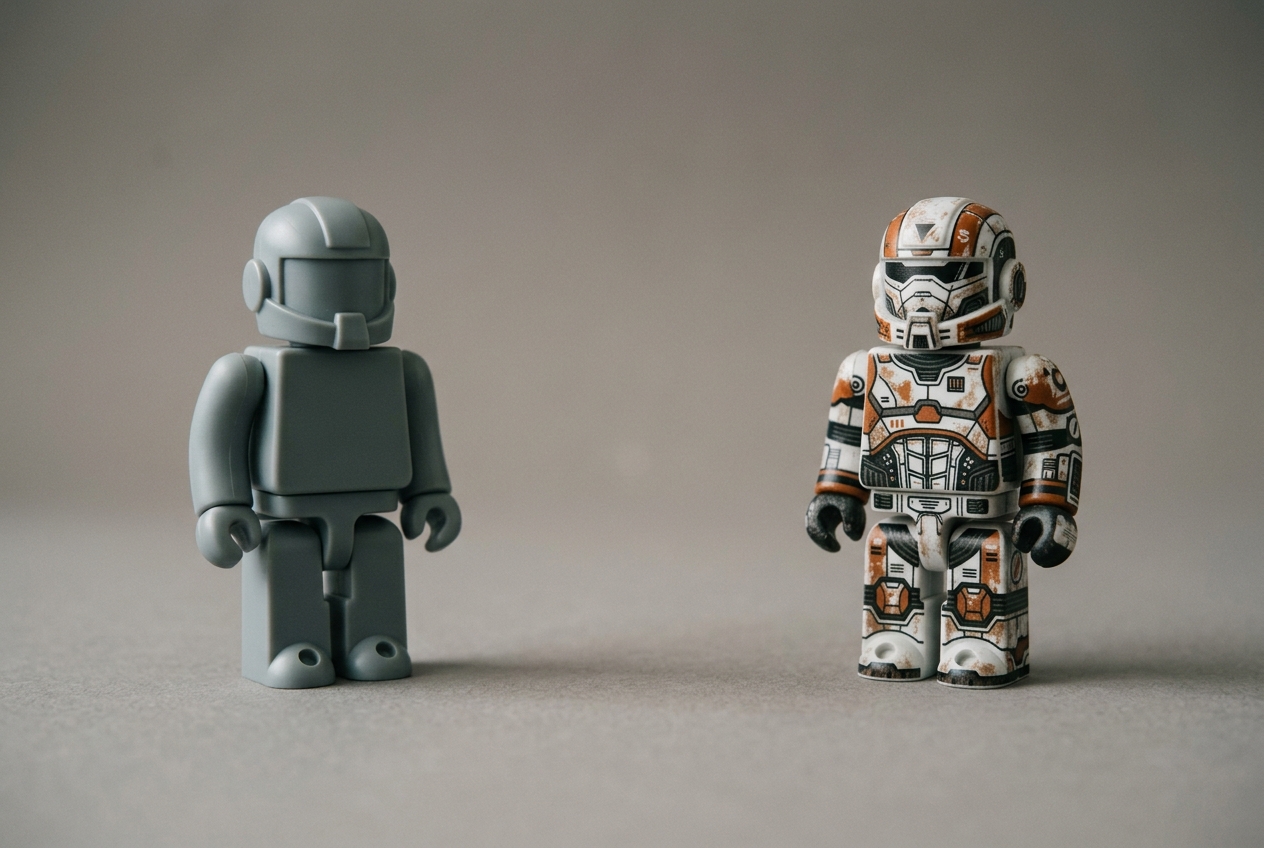
"Is it real?" is the most common question before a second-hand purchase, and it contains two questions that rarely get separated: is this a LEGO figure? and is somebody trying to fool me? The second is the more interesting one, because not every figure that is not LEGO is a fake.
Four things, and only one of them is a fake
The original LEGO figure
From the factory, with every characteristic listed below.
A figure from another brand
Cobi, Qman, BlueBrixx, Sluban and a dozen others sell their own figures under their own names. They are compatible, but they do not present themselves as LEGO — they carry their own moulded branding and their own logo on the box. Buying one is not buying an original, and it is not being deceived either. Whether such a figure comes too close to the protected LEGO figure shape is a question between manufacturers that regularly occupies the courts; for you as a buyer it is not a counterfeit.
The custom
A figure with an original design that never officially existed, usually printed on genuine LEGO parts — but not necessarily. A custom does not want to be taken for an original; it wants to show something that exists nowhere else. What that means, and how to tell good work from bad, is in What are custom minifigures?.
The counterfeit
And this is the only one of the four: a figure pretending to be a LEGO product. Recast parts with imitated branding, copied packaging, the words "LEGO minifigure" in the listing. Here you are being deceived — in the other three cases you are not.
So the checks below answer the factual question first: is this a LEGO part? What follows from the answer is the second step.
On the object
1. The moulded branding — the check you can actually read
The strongest signal, and it is not a matter of feel: on a genuine figure the maker's name is literally written on it, on every single part. Not hidden away, but in fixed places — once you know them, you can check a figure in twenty seconds.
Where to look:
- The torso, at the neck. The small stud the head sits on. The easiest spot, because you only have to pull the head off.
- The legs, inside the foot. Turn the figure over. Each leg is hollow underneath, and the small cylinder inside that cavity carries it again.
- The hips, from below. On the underside of the hip piece, between the legs.
- The head, from inside. The head is hollow; hold it to the light and look in from underneath — it is there in the dome.
- Accessories and headgear. Helmets, hair and hats carry it inside, usually near the rim.
Every part is its own part, and that is what makes this check so useful: an assembled figure can mix genuine and non-genuine pieces — a real head on a recast torso is the classic second-hand case. Check torso, legs and head separately, not the figure as a whole.
Look not only at whether the name is there but at how: evenly deep, cleanly rounded, centred letters, often with a small mould number beside them. Imitations are shallower, blurred, slightly distorted or minutely misproportioned — and some recasts carry nothing at all, because the branding was lost in the moulding.
If your eyes will not cooperate at that size: phone camera with macro or zoom, and hold the part at an angle to the light. The recess then throws a shadow that makes the letters readable.
2. Clutch power
Put the figure on a plate you know is genuine and lift it by the head. The figure must come along and release with perceptible resistance. Too loose means the wrong material or the wrong tolerance. Too tight means the same — only more expensive, because you deform the leg getting it off.
3. Material and surface
Genuine parts have an even, fairly matte satin sheen. Recasts often look either too glossy or dull and slightly soapy. Tilt the part into the light: streaks, clouding in the colour or a visible flow line across the surface do not belong there.
4. Gate marks and flash
Every injection-moulded part keeps a point where it was separated from the sprue. On genuine parts it always sits in the same inconspicuous place and is cleanly finished. Perceptible flash along leg edges, the neck or the inside of a hand is a clear sign.
5. The head fit
The head should seat with defined resistance and then turn without wobbling. A foreign head on a genuine torso — or the reverse — shows up here immediately.
6. The colour
Hold the part next to an original in the same colour. LEGO colours are remarkably consistent over years; recasts almost never hit them exactly. A red drifting slightly to orange, or a grey with a blue cast, is obvious side by side and invisible alone.
7. The print
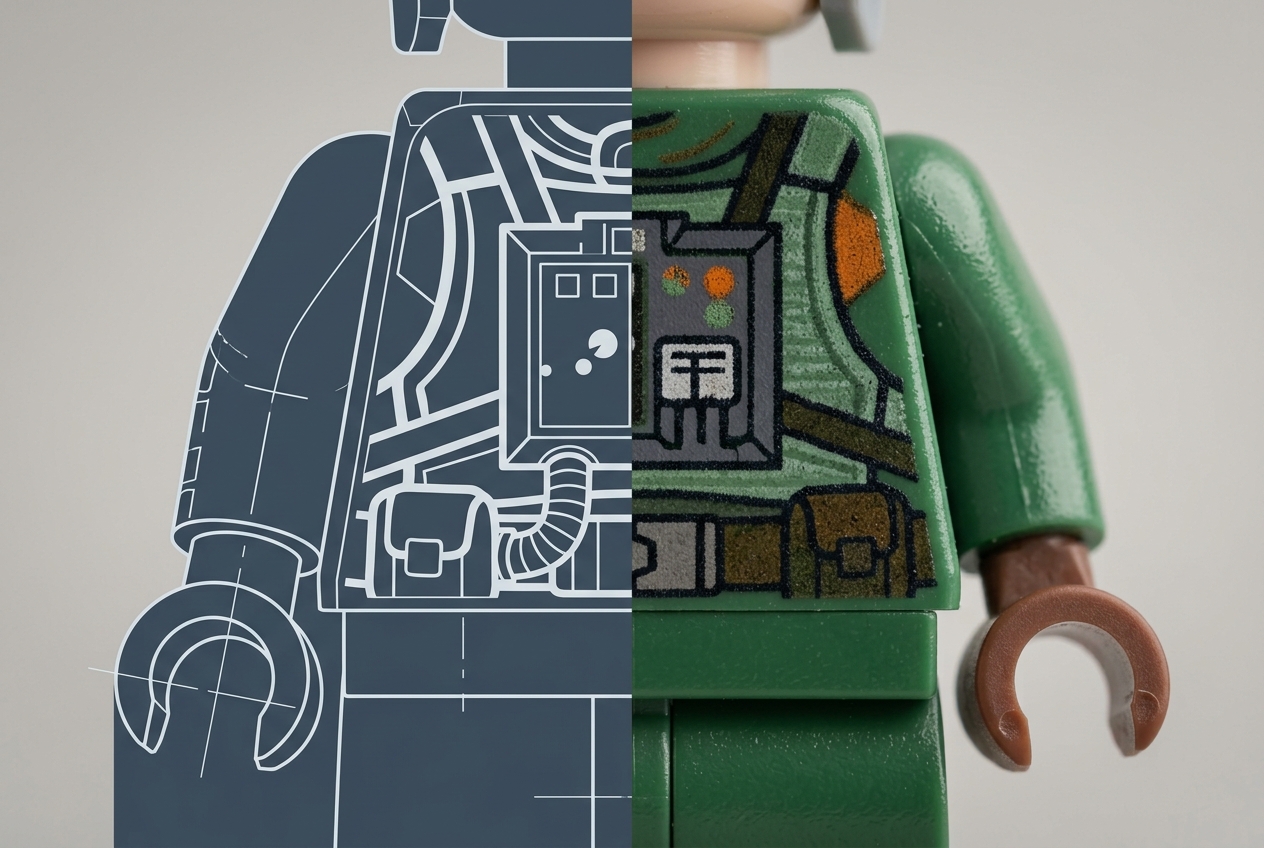
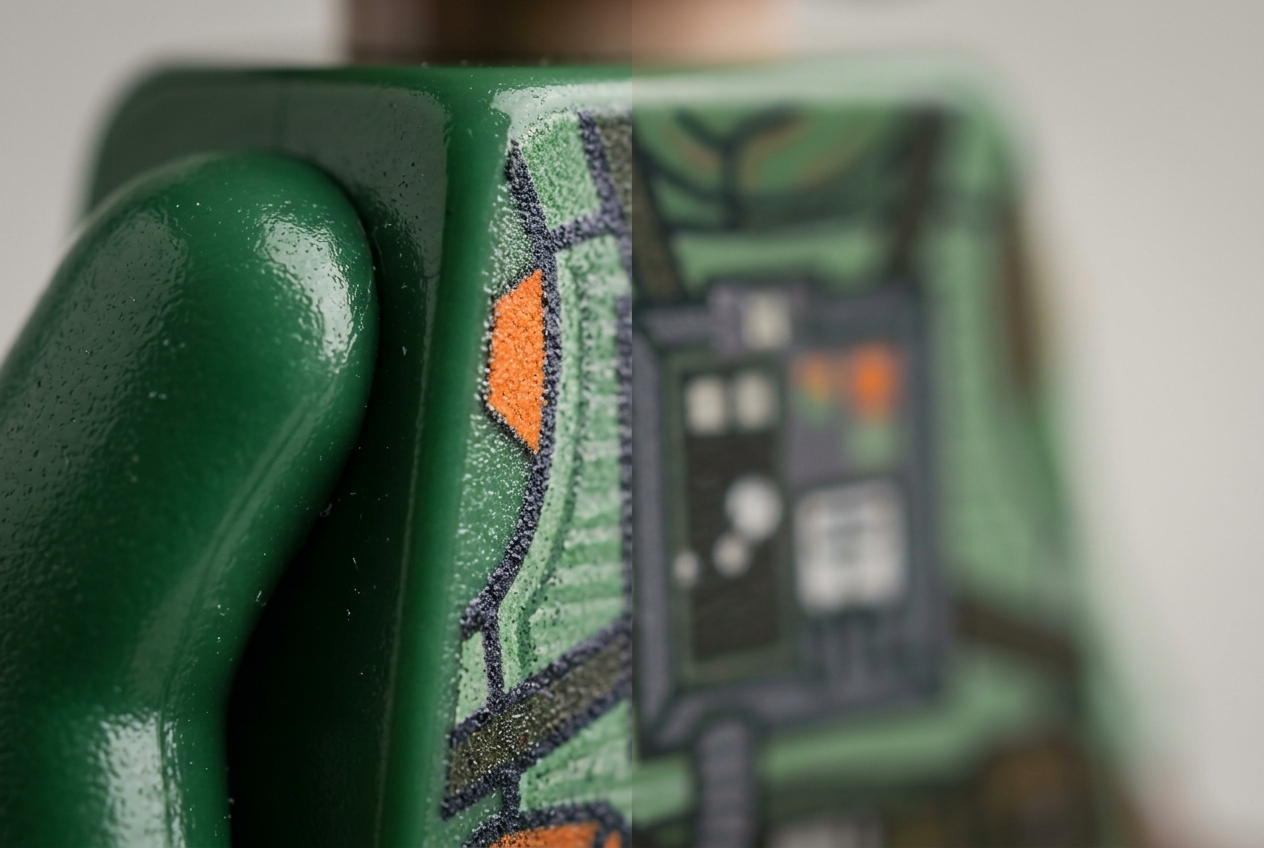
Factory printing is smooth: run a fingernail across a printed edge, it must not lift and should barely be felt. Cheap printing sits perceptibly on top. Also look at the coverage of light colours on dark parts and at misregistration between two colours.
One important special case: a cleanly printed part with flawless moulded branding may still not be factory printed. That is exactly what a custom on genuine parts is — genuine element, other people's print. Not a contradiction but the third category above.
In the listing
8. The price
Genuine parts have a floor. Twelve "rare" figures for twenty euros is not a bargain announcement, it is a product description.
9. The quantity
Permanently in stock, in any amount, several hundred sold by a nameless retailer: that is ongoing production, not leftover stock.
10. Wording and photos
A serious listing names what it sells. Counterfeiters scatter the brand name through the title because that is how they get found — and work strikingly often with renders, or with photos that visibly are not the item you will receive.
The catalogue counter-check
If the part looks genuine but the figure as a whole appears in no set you know: search it by name or description in a catalogue that holds official and custom figures.
- An official figure looks exactly the same → you either have the original or a reproduction of it. Back to the checks above.
- Nothing comparable turns up → you are probably looking at an original design, that is, a custom.
That is why the Plasticfolk catalogue keeps both kinds side by side instead of in two separate databases.
Two caveats: a custom may resemble an official figure where it visibly develops it further — a different unit, an armour variant, another scene. And conversely, an invented name does not turn a copy into a design. What counts is what you can see on the figure, not what it is called.
Frequently asked questions
Is a figure without moulded branding automatically fake?
Nearly always, yes — but check the right spot first. On heavily played-with figures it can be worn away, and on some parts it sits less conspicuously than on others. A missing name on an otherwise flawless part is more suspicious than one on a scratched part.
Are Cobi, Qman or BlueBrixx figures counterfeits?
No. Those are separate brands with their own products. It only becomes counterfeiting when something pretends to be LEGO.
Are custom minifigures real LEGO?
The parts are, the figure is not. Serious makers print on genuine LEGO elements; the result is still not a LEGO product and must not be sold as one. More on that in Are custom minifigures legal?.
Do non-LEGO figures hold on real models?
Usually, but rarely as well. Differing clutch power is the most common annoyance, and it often shows up only after the second or third rebuild.
If you buy a lot, document it: Plasticfolk records what you bought, where and at what price — official figures and customs in the same catalogue.