Monochrome LEGO minifigures: prototypes, factory parts or fakes?
A red Darth Vader, an unprinted white clone trooper: single-colour Star Wars figures are sold as "prototypes" and appear in no catalogue. Where they come from, why they have no SW number and what the word "prototype" is really worth here.
A Darth Vader that is bright red from helmet to feet. A clone trooper in pure white without a single print. A TIE pilot moulded in trans-black. Anyone who searches eBay, Instagram or Facebook groups for Star Wars figures runs into pieces like these sooner or later. They are offered as a "prototype", a "test figure" or a "factory error", often with the promise "100% genuine LEGO". No catalogue lists them, and none has an SW number. What is going on?
What this is about – and what it is not
Collectors call figures whose parts all share one colour monochromes or monofigs. The word covers two very different things.
The first is figures people assemble themselves: head, torso, arms, hands, hips and legs in one colour, collected from regular, unprinted parts. That is a hobby of its own with its own checklists, and it has nothing to do with the puzzle in this article.
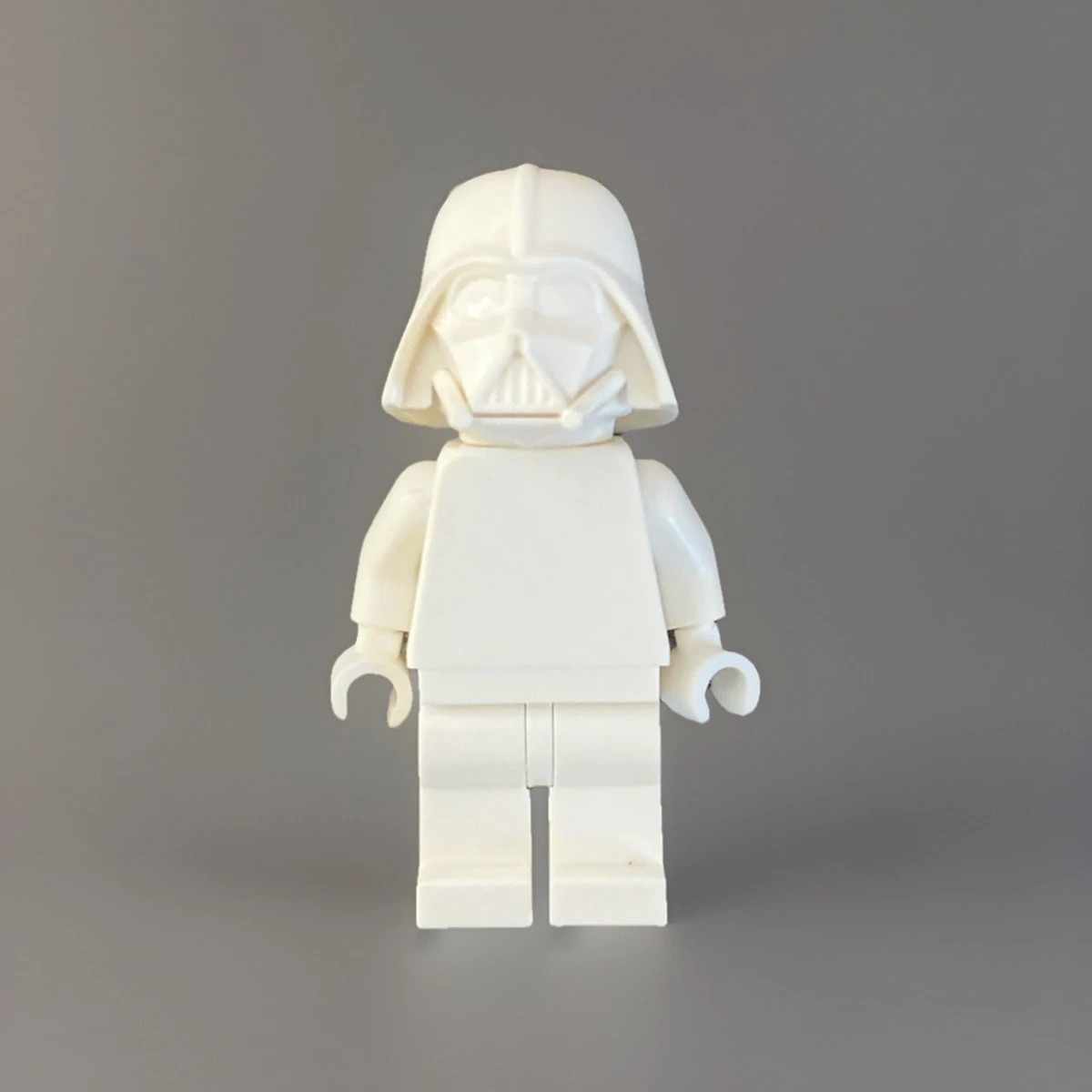
The second – and the subject here – is complete figures moulded in shapes that otherwise only exist printed and in several colours. A Vader helmet in red, a clone trooper helmet with no markings at all, a C-3PO in trans-blue. You cannot gather these parts from sets, because LEGO never put them into a set in these colours. They arrive as a finished figure from a single source: production.
Which ones exist
There is no complete list, and that is in the nature of the thing. What keeps turning up:
- Darth Vader – by far the most common, in red, blue, green, white, yellow and almost every transparent colour. The two-piece helmet makes him especially sought after.
- Clone troopers, Phase 1 and Phase 2, above all in plain white – which is how the helmet looks before it is printed.
- Stormtroopers and TIE pilots, the latter often in trans-black.
- C-3PO and Obi-Wan Kenobi in transparent colours.
- On top of that blasters, C-3PO heads, Emperor holograms, TIE pilot helmets and even Rey's hair, all of which the Holo Brick Archive listed in rainbow colours in 2021.
- One-offs such as Max Rebo, and beyond Star Wars a transparent Iron Man helmet or a Tarfful head, both named in collector forums.
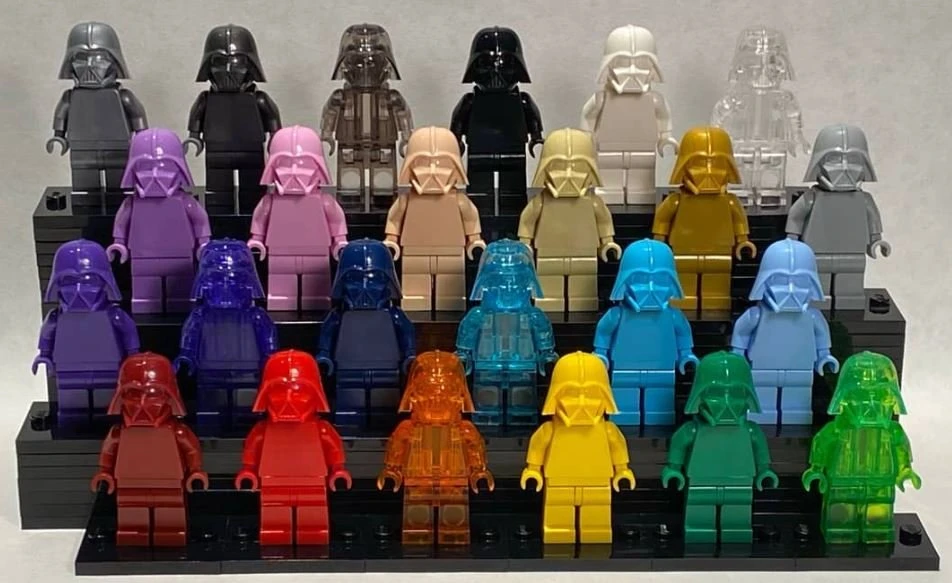
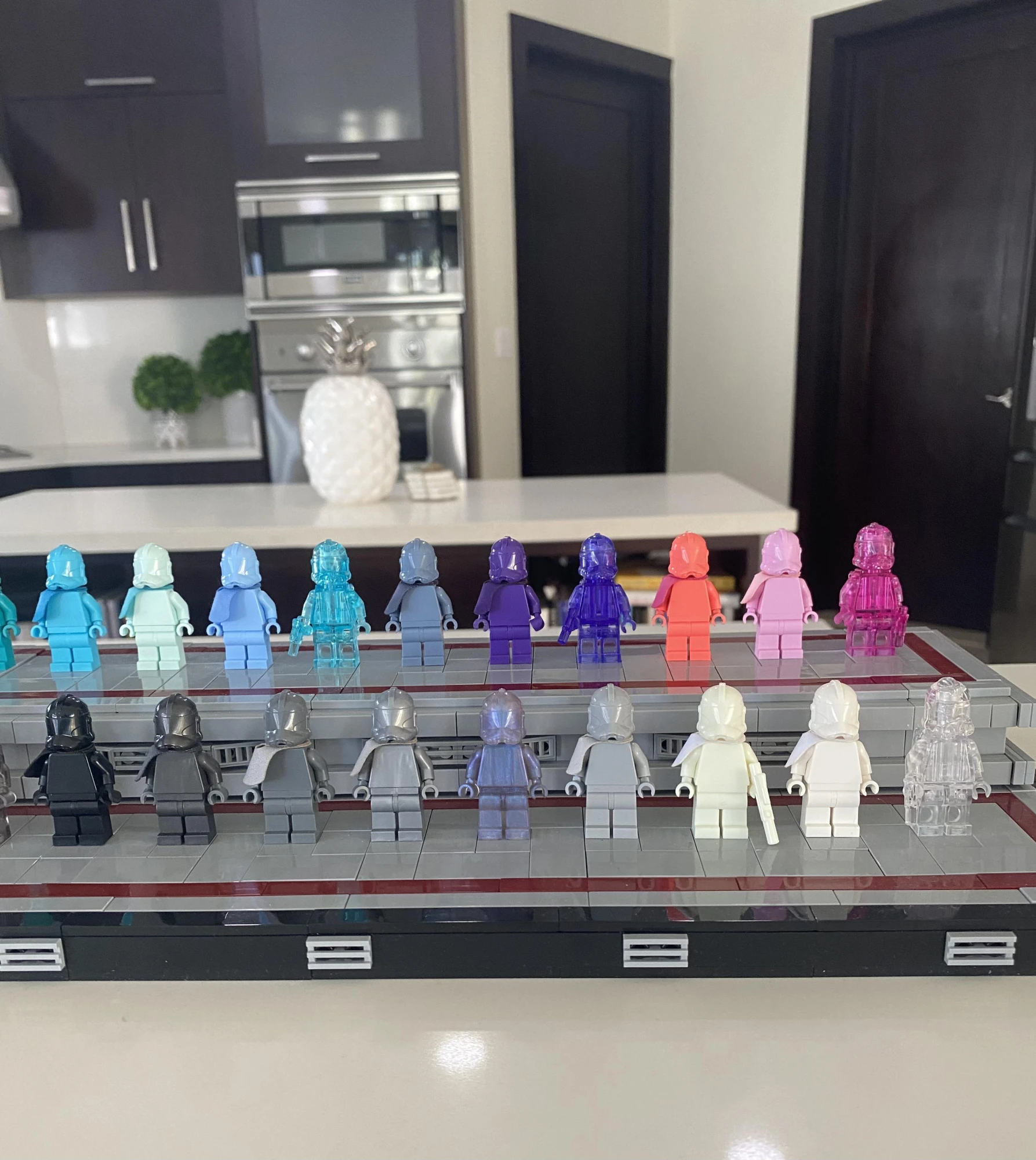
What stands out is how much the supply concentrates on Star Wars, and within it on Vader. Collectors noticed too: one member of the Eurobricks forum wondered in 2021 why so many of them were Vaders. The obvious answer is demand: a red Vader sells better than a red villager.
From granulate to figure: how a minifigure is made
To see where a red Vader can come from, it helps to follow the path every ordinary figure takes.
The colour is set at moulding, not at printing. LEGO receives plastic as granulate, stores it in silos and melts it in injection-moulding machines at around 230 degrees Celsius. Which colour a part has is decided by the granulate that happens to be in the machine. Moulding itself is almost entirely automated, and driverless carts take the parts on to the next station.
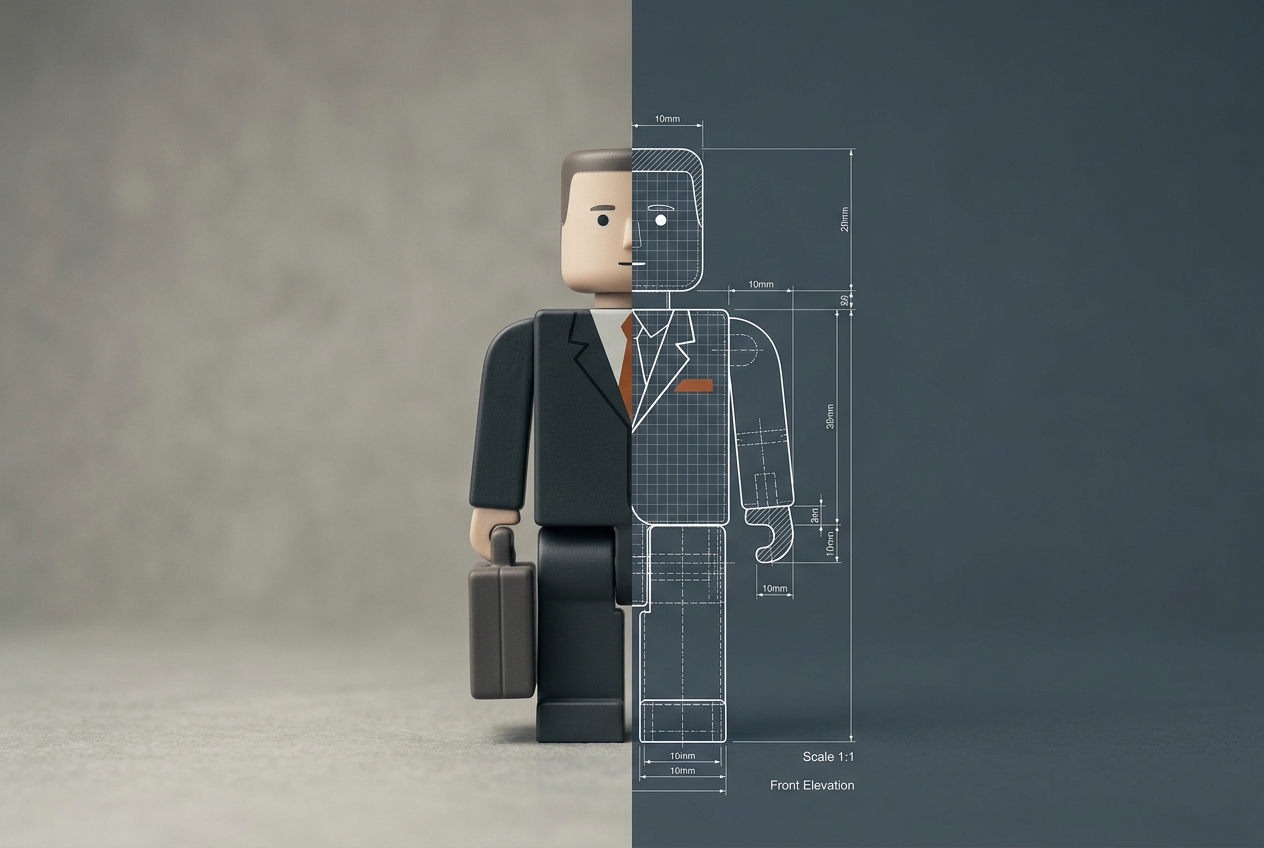
Every figure is nine parts, and each comes from a mould of its own. Head, torso, two arms, two hands, hips and two legs are moulded separately. How fast that goes is shown by pictures LEGO gave New Elementary in 2018 for the minifigure's 40th birthday: a single head mould now produces 128 heads every 14.7 seconds, more than eight a second.
Printing comes afterwards, on a line of its own. At the Kladno plant in the Czech Republic, where LEGO prints and assembles figures, heads run on holders through pad printing one colour at a time, with a dryer in between. Machines push the hands into the arms and press legs and hips together, and only then are the legs printed – as the photos from Kladno show. At the end, staff pack the parts and watch for the machines' mistakes.
What is left over is meant to go back into the loop. LEGO writes that in all its factories element waste is made into new bricks again, and that in 2024 96 percent of production waste was reused, recycled or recovered.
For the puzzle in this article that means three things:
- An unprinted white clone trooper is an intermediate product. Every clone trooper helmet is white and unprinted before it reaches the printer. Someone at the line does not have to make anything, only take something.
- A red Vader, by contrast, has to be moulded in red. That takes a Vader mould running with red granulate – in a mould test, during a colour change or on purpose. At eight heads a second, a few minutes produce thousands of parts. The quantity on the market is therefore no argument against a factory origin.
- The leak is the scrap. Parts in the wrong colour are supposed to be melted down. Whoever diverts them first puts them into circulation without anything missing from the books.
Where they come from
LEGO has never commented on these figures. Little is documented, and much of what listings say is sales copy. What can be said:
As a rule they are real LEGO. Owners consistently report the LEGO logo in the usual places, such as on top of the neck stud and inside the legs, and shapes that match the official ones exactly. Transparent parts cannot be painted that way afterwards either: what is see-through was see-through when it was moulded. Fakes exist all the same, precisely because these pieces make money.
They very probably come straight out of a factory. LEGO moulds among other places in Billund, in Kladno in the Czech Republic, in Nyíregyháza in Hungary, in Monterrey in Mexico and in Jiaxing in China. Collectors on Eurobricks who have watched this market for years put these figures in a category of their own, which they call "nightshift" or simply "factory": parts made on LEGO machines in LEGO moulds but never meant for sale. According to those reports, the same sellers often offer regular figures months before the matching set comes out – a clear sign of a link into production. In Mexico, the paper SDP Noticias reported allegations from collectors that the Monterrey plant was producing figures beyond demand for resale; it stressed that none of this is confirmed.
How exactly they are made, nobody knows publicly. The romantic version – an employee secretly runs the machine in red – sounds like legend, but it has a true core: at least one such case is documented, more on that below. Besides, every factory produces parts in odd colours anyway: in mould tests, during colour changes between two jobs and as scrap that should have been melted down. Assembling a complete figure from such parts then only takes someone with access.
What insiders and experts say
We found no official statement from LEGO and no on-the-record account from anyone in a factory. What exists are reports from collectors who asked, and from forum members who have watched this market closely for years. They contradict each other, and that is exactly what makes them telling.
The documented case. Kevin Downard, chief archivist of the Holo Brick Archive, wrote up the story of the "prototype" Vaders in 2021. Red Vader helmets first appeared in the early 2000s, hundreds of them on BrickLink for a couple of dollars each, an estimated 200 to 500. The quantity itself raised suspicion: an investigation followed, and in the end a LEGO employee was dismissed. He had been moulding helmets with the real moulds on the plant's machines for some side income – which is why they carry the correct mould and cavity numbers. In 2018 it started all over again, once more with a red Vader helmet, this time the newer two-piece one. According to Downard the trail leads to the Monterrey plant in Mexico; the copycat had not been caught. By early 2021 there were 24 colours, six of them transparent.
For a factory origin:
- A collector reported in 2021 in the Eurobricks thread on monochrome figures that he had written to LEGO employees several times because the legal side worried him. The answers were evasive: they knew about the figures and were letting it happen; from another source he had heard there was an investigation. His own guess: as long as quantities stay small, LEGO hardly cares.
- Another member, who keeps a list of the mould numbers found on these figures, wrote in 2023 in the same thread that the figures are made in LEGO factories from LEGO material in LEGO moulds, only without permission – "not fake or counterfeit but not really legitimate either". Earlier runs came from China and were polycarbonate, newer ones from Mexico. His strongest argument: in 2023 LEGO switched trans-black to a new shade, and exactly that new shade turned up on the factory figures at the same time.
Against a factory origin, or at least against the story told about it:
- A long-standing member objected in 2021 in the thread on authenticity: the plants run around the clock anyway, LEGO watches social media closely, and late-night side runs at Kladno would be noticed at once. The figures might be real LEGO; the night-shift story is not.
- Another worked out what a colour change involves: purging the huge injection units, switching off printing, cutting the line off before packing, and doing it again for every colour. The downtime, he argued, is too large to go unnoticed.
- In 2023 a collector with more than 250 of these figures spoke up and considered at least some of them copies from other moulds: hands snapped, and colours did not match between batches. Another member explained the odd hands by the fact that LEGO moulds hands from a different, tougher plastic than the rest of the figure – which gives official figures slightly off-colour hands too.
- One participant also passed on that a LEGO designer had said at a fan weekend that transparent torsos with transparent arms are not feasible, because the parts have to be different plastics for the arms to come off without breaking. Owners of transparent factory figures do report strikingly stiff joints.
The picture that emerges: someone in a plant running the real moulds on the side for their own account is documented at least once, and it ended in a dismissal. Whether that happens at night or between two jobs is secondary. Besides that there are very probably copies from other moulds as well – and neither is a prototype.
Are they really prototypes?
Mostly not – at least not in the sense the word promises.
A prototype in the proper sense is a design piece: an early stage of a figure, printed or moulded to judge its shape, print or colour before production starts. Such pieces exist, but they rarely leave LEGO and are correspondingly scarce and expensive. The collectors on Eurobricks therefore draw an explicit line between "genuine prototypes" and factory parts. One of them puts it bluntly: nightshift figures are "absolutely not prototypes".
The colours tell more than you might think. For mould tests, by Downard's account, LEGO has traditionally used red, and in recent years light bluish grey; the right term for such parts is not prototype but test shot. That the red Vader came first therefore fits – and made it the perfect cover. But why would LEGO test a Vader in green and twelve transparent shades when he ships in black? And why a finished figure with matching arms and hands when the question is a mould? Then there is the material: genuine transparent test pieces are often polycarbonate, while many of the transparent figures sold today are ABS, recognisable, according to owners on Eurobricks, by stiff joints and less clear plastic.
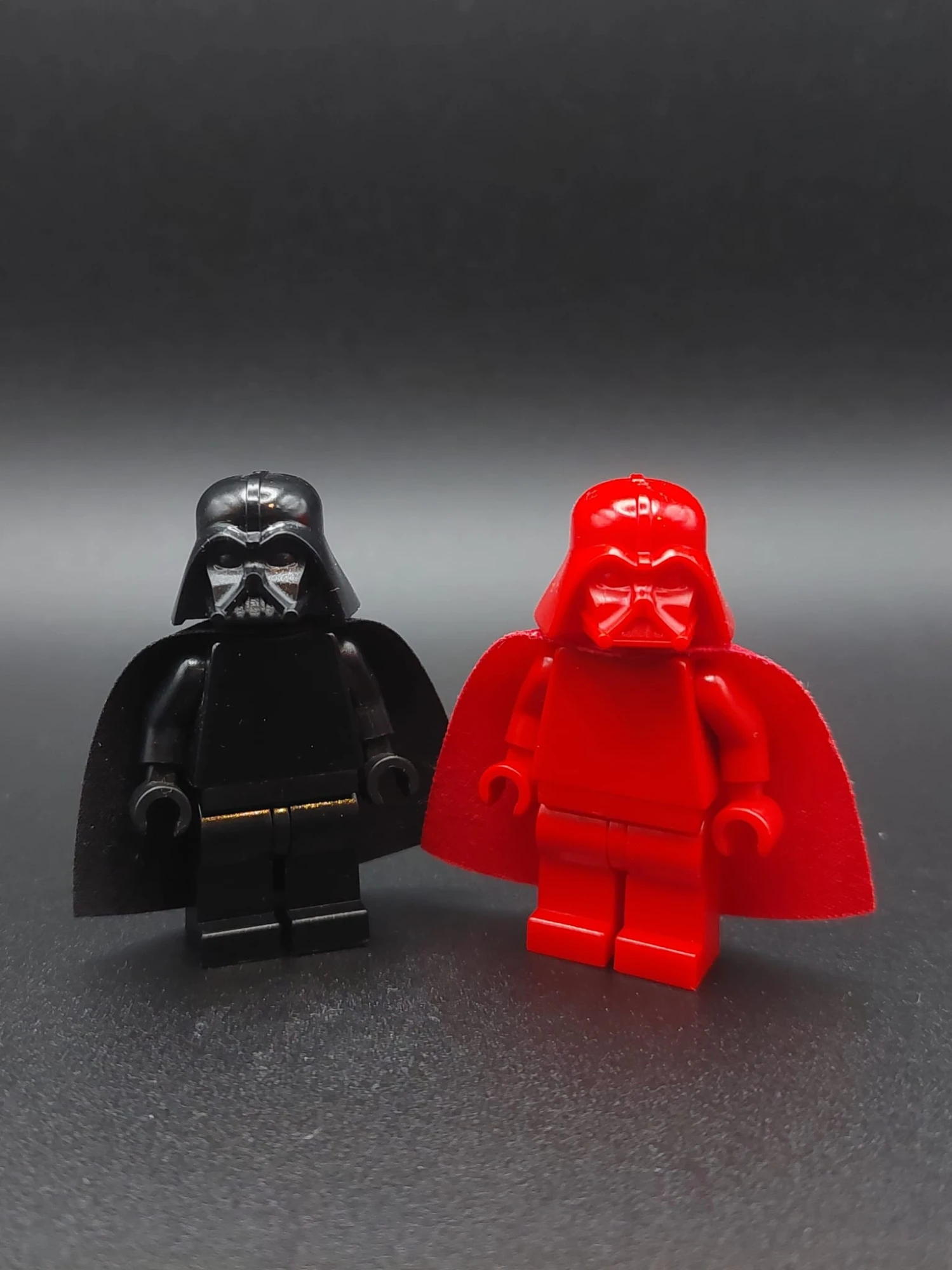
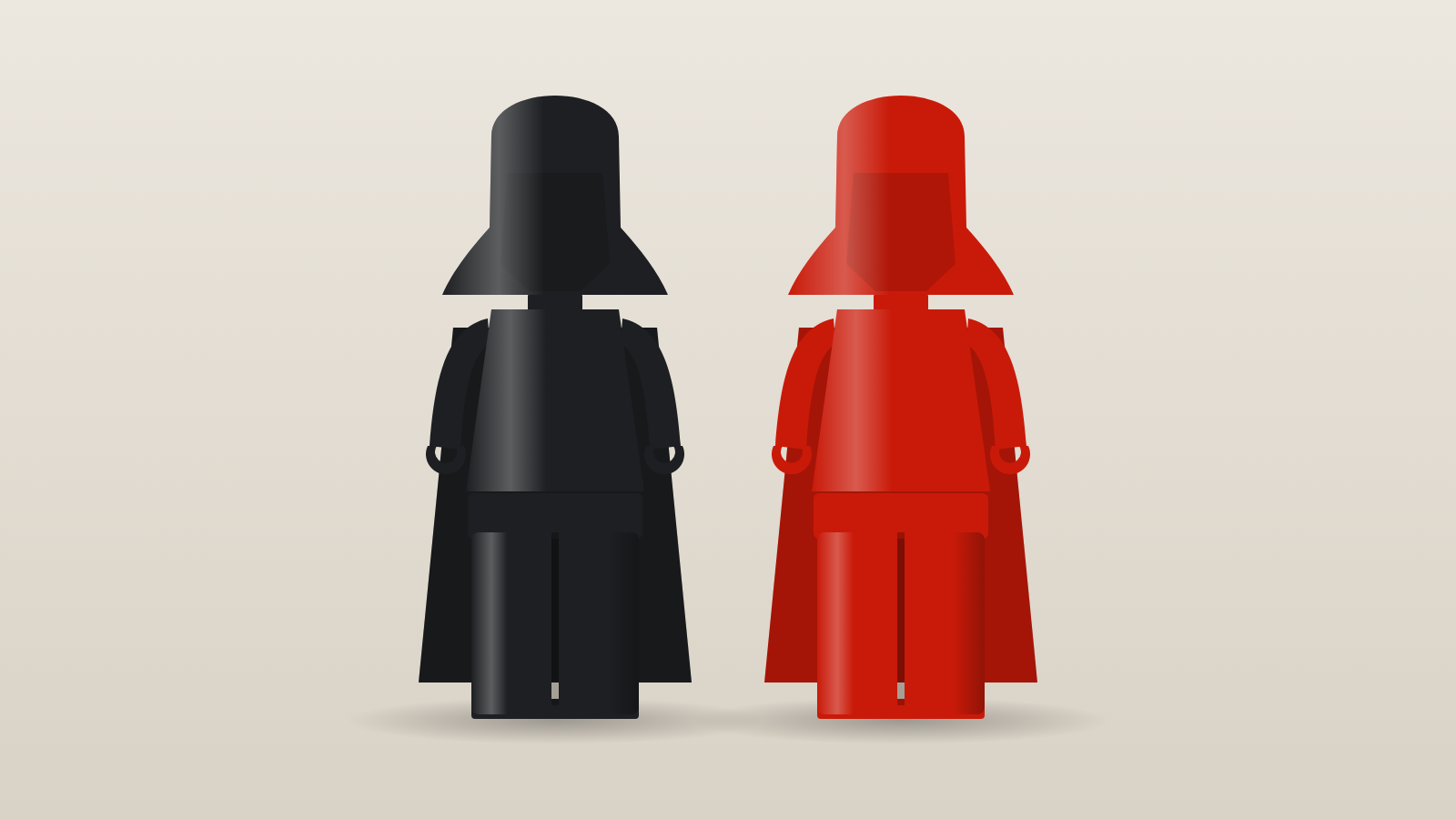
This is what it looks like side by side: a reader photographed their two Vaders for us, one black and one red, neither with any print at all. There is more from the collection on Instagram at scarif_bricks.
Still, the word "test" is not always wrong. Brickipedia lists the red Vader helmet as a part LEGO moulded to test the mould and never put in a set; the story of the dismissed employee shows how thin the line between test piece and side income can be. A single part in an unusual colour can genuinely come from a mould test. A whole rainbow of complete figures, on the other hand, is not a test run but a product range.
Why they have no SW number
The SW numbers collectors use to name Star Wars figures – from sw0001 to well past sw1500 today – are assigned by BrickLink, not by LEGO. And BrickLink only catalogues a figure if it came in an officially released product: a set, a polybag, a giveaway, a promotion. Unreleased items, says BrickLink's help page, are accepted only with proof, and for technical reasons only as sets. A figure that was never sold has no place there, however genuine its plastic.
That this has nothing to do with being one colour is shown by the catalogue itself. Where LEGO released single-colour figures officially, they have numbers as a matter of course:
In 2021 the set 40516 Everyone is Awesome*, by LEGO's design chief Matthew Ashton, lined up eleven single-colour figures in the colours of the Pride flag. BrickLink lists them as tls100 to tls110. The FIRST LEGO League brought more single-colour figures in 2023, among them a black magician and a white ballerina, and the statues in Harry Potter and Architecture sets are monochrome and catalogued as well.
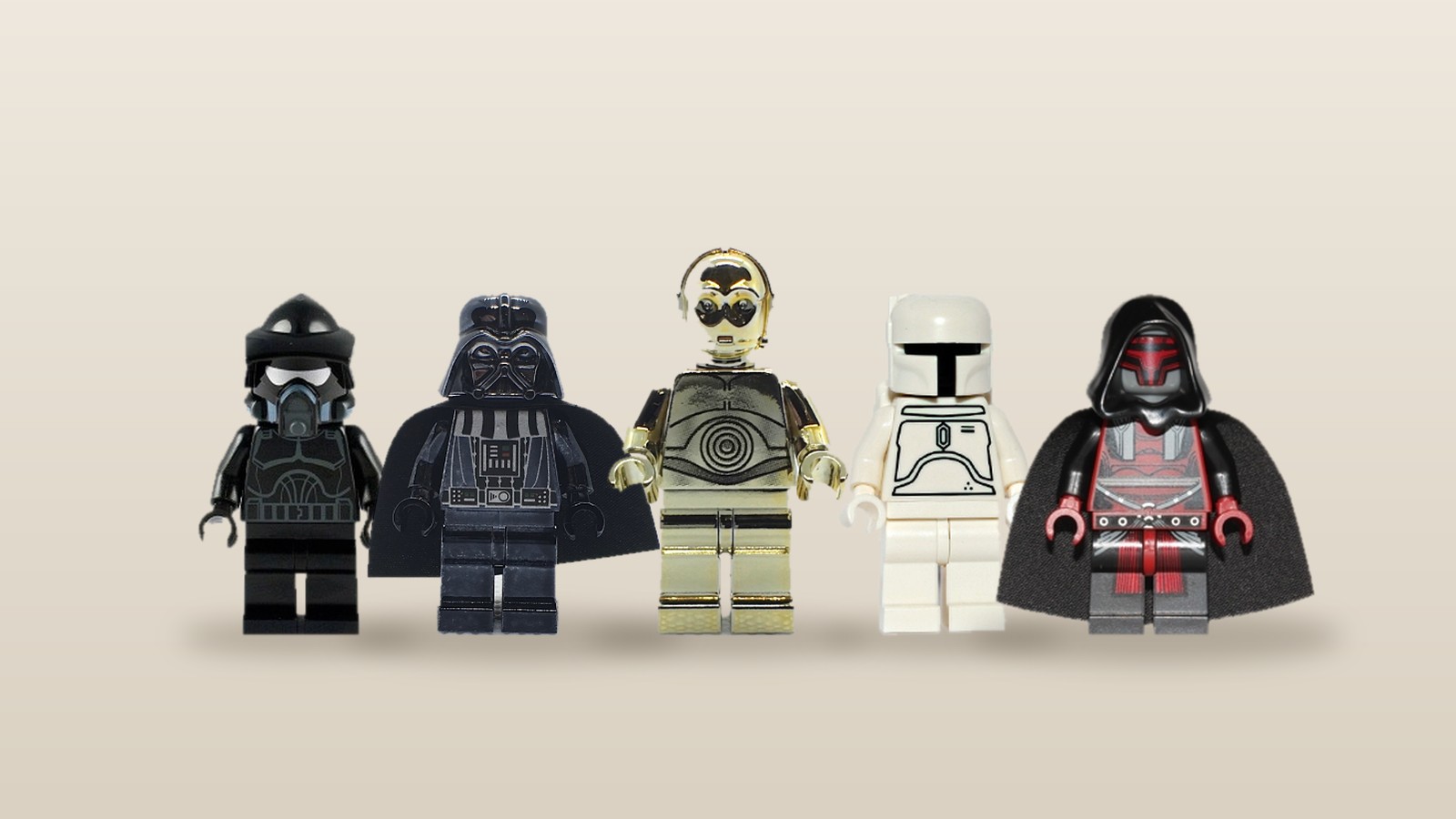
Star Wars has its official special colours too – they were sold, and so they are numbered. The chrome-gold C-3PO was packed into 10,000 randomly chosen sets in 2007 for Star Wars' 30th anniversary, and a chrome-black Vader followed as a promotional figure.
And then there is the case that answers the question best: in 2010 LEGO released a white Boba Fett as a promotional figure – a nod to the white prototype Kenner used to develop the figure in 1979. He looks like a prototype but is a product, and that is why he is sw0275.
Why they are so hard to find
"Rare" is relative with these figures. They are rare in shops, in sets and in catalogues – there they do not exist at all. On the secondary market, by contrast, they have become more common in recent years. Collectors on Eurobricks quoted prices in 2021 of roughly 10 to 15 US dollars for an opaque figure and 30 to 50 dollars for a transparent one, and noted that some transparent colours in particular were getting cheaper and more common. Single helmets, according to the Holo Brick Archive, were available on BrickLink in 2021 for around 25 dollars – while the same figures, auctioned as "prototypes" on Catawiki, went for far more.
That you still seldom see one has several reasons:
- There is no regular sales channel. Selling such figures takes a link into production, and few people have one.
- Quantities are kept small. Collectors have observed individual sellers releasing only a few pieces at a time to keep prices up.
- The big platforms ignore them. Without a catalogue number they appear in no figure search on BrickLink, and there are no price statistics.
- They are a grey area. Something that left a factory without being sold strictly belongs to the manufacturer. That keeps reputable dealers away.
Home-made: stripped prints and upgraded figures
Where a single-colour figure makes money, people will build one. That takes no factory, only a cloth and the right product.
Prints can be removed, and that is no secret. Since 2009 the Eurobricks forum has carried a guide on rubbing the print off torsos and other parts with Brasso, a metal polish with a very fine abrasive. Collectors of single-colour figures have traded experiences there for years: Brasso works, but it can leave scratches in the direction of rubbing, a "ghost" of the old print and a chemical smell; the scratch remover Quixx is often named as an alternative that leaves fewer traces.
Acetone and nail polish remover, on the other hand, are a bad idea. Acetone dissolves ABS, the plastic almost every LEGO part is made of. Hobbyists use exactly that to stir plastic shavings and acetone into a slurry for gluing and filling. On a figure it means the surface turns dull and soft, and at worst the part warps. Most nail polish removers are largely acetone. Anyone who "wipes off" a print with it usually takes some plastic along – traces a practised eye can see.
Stripped parts and official single-colour figures can be combined into a "prototype". We found no documented case of a seller demonstrably doing this. But the route is open, and it is simple. A clone trooper helmet is white and printed; rub the print off, put it on the torso, legs and head of the white figure from Everyone is Awesome, and you have a "white monochrome clone trooper". Vader's helmet is black to begin with; with its mask stripped, on the black figure from the same set, it becomes a "black prototype Vader". The single-colour bodies are cheap, because LEGO sold them officially.
Often not even a solvent is needed. Some helmets come unprinted from the factory: Vader's older one-piece helmet, for instance, is plain black. Put on the black figure from Everyone is Awesome, it makes a "black monochrome Vader" without any work at all. The same works in any colour in which LEGO has sold unprinted body parts and an unprinted helmet – grey, incidentally, is not among the set's eleven colours, so there the parts would have to be gathered one by one. A figure like that is genuine LEGO, part for part. It is still neither a prototype nor a factory figure, and that is exactly what makes it such a convenient sales trick: it passes every authenticity check that asks about the LEGO logo.
What stripping cannot do: change the colour. It will not make a red Vader helmet, let alone a transparent one. People do dye parts too – hobbyists report experiments with dye for synthetic fabrics – but by their own accounts the results are unreliable, hands barely take colour, and the outcome matches no LEGO colour. For a fake that means the easiest figures to recreate are the ones whose colour already exists officially – white, black, the basic colours. The white clone troopers and stormtroopers offered as "unprinted prototypes" deserve a second look for exactly that reason. With red, green and transparent, the colour itself argues that the part was moulded that way.
In the end it is almost always about money. A stripped helmet and a figure from a 35-euro set cost a few euros together. With the word "prototype" in the title, figures like these are listed on eBay for three-figure sums, while collectors in 2021 quoted 10 to 50 US dollars for genuine factory figures. The difference pays for a story, not a figure. Among collectors themselves this is no taboo: anyone who strips a print for their own collection says so – in the Eurobricks thread such parts are openly called "cheated colors". It becomes a problem only when the work is kept quiet and sold as provenance.
Where to find these figures
There is no shop and no catalogue. Anyone who searches deliberately will still find them – mainly in these places:
- eBay. The biggest market, and the most confusing. Search with the figure's name plus terms like "monochrome", "unprinted", "prototype" or "test" – sellers use all of them, often interchangeably. Collectors on Eurobricks observe that many listings come from North America, Mexico and Asia, even when the item location says otherwise; orders from outside your own customs area add duty and import tax.
- Facebook groups and Instagram. There are groups dedicated to monochrome figures where, according to members, such pieces are offered and traded all the time. They are also the likeliest place to learn which colours are turning up right now.
- Classifieds and international platforms. Kleinanzeigen in Germany, Mercari in the US, Mercado Libre in Mexico. Add auction houses such as Catawiki, where the word "prototype" pushes bids especially high. On Mercari a YouTuber deliberately let himself be scammed with supposed "prototypes" for a video – platforms with weak buyer protection are the riskiest for these figures.
- BrickLink. Without a catalogue number there is no search for the figure and no price overview. Individual sellers still offer individual parts; you find them through the parts search, not through the figure.
- Brick fairs and fan events. Anyone who wants to hold the figure before paying gets the best chance here to check the logo, the joints and the surface in person.
For context, the collector community itself helps: in the Eurobricks thread on monochrome figures members have kept lists of known colours, materials and mould numbers for years. Compare a listing against them and you quickly see whether a colour is already known – or whether someone is inventing something new.
What to look for when buying
Anyone who wants one is buying a curiosity, not an investment. A few things help all the same:
- Ask about the LEGO logo – on the neck stud, inside the legs, on the helmet rim – and ask for sharp photos.
- Compare the colour with genuine LEGO parts. A green that does not exist in LEGO's palette is a bad sign.
- Look for signs of work. Dull patches, fine scratches running one way, a faint shadow of the old print or a chemical smell point to a stripped part. White and black deserve the closest look.
- Do not pay for the word "prototype". Genuine prototypes have a traceable history, usually via former employees or documented auctions. A figure in series, offered by the same seller in twenty colours, is not one.
- Expect no resale value. Without a catalogue number, a price guide or an official origin, only the next buyer decides what it is worth.
In the end, monochrome factory figures are what they appear to be: genuine LEGO plastic from genuine LEGO moulds, only never meant for us. A red Vader is not a glimpse into LEGO's design department but one behind the scenes of a factory – and that is exactly its appeal.
Affiliate link: if a purchase is made through a link marked with an asterisk (*), Plasticfolk receives a small commission. The price stays the same.
Last edited on Nov 23, 2026