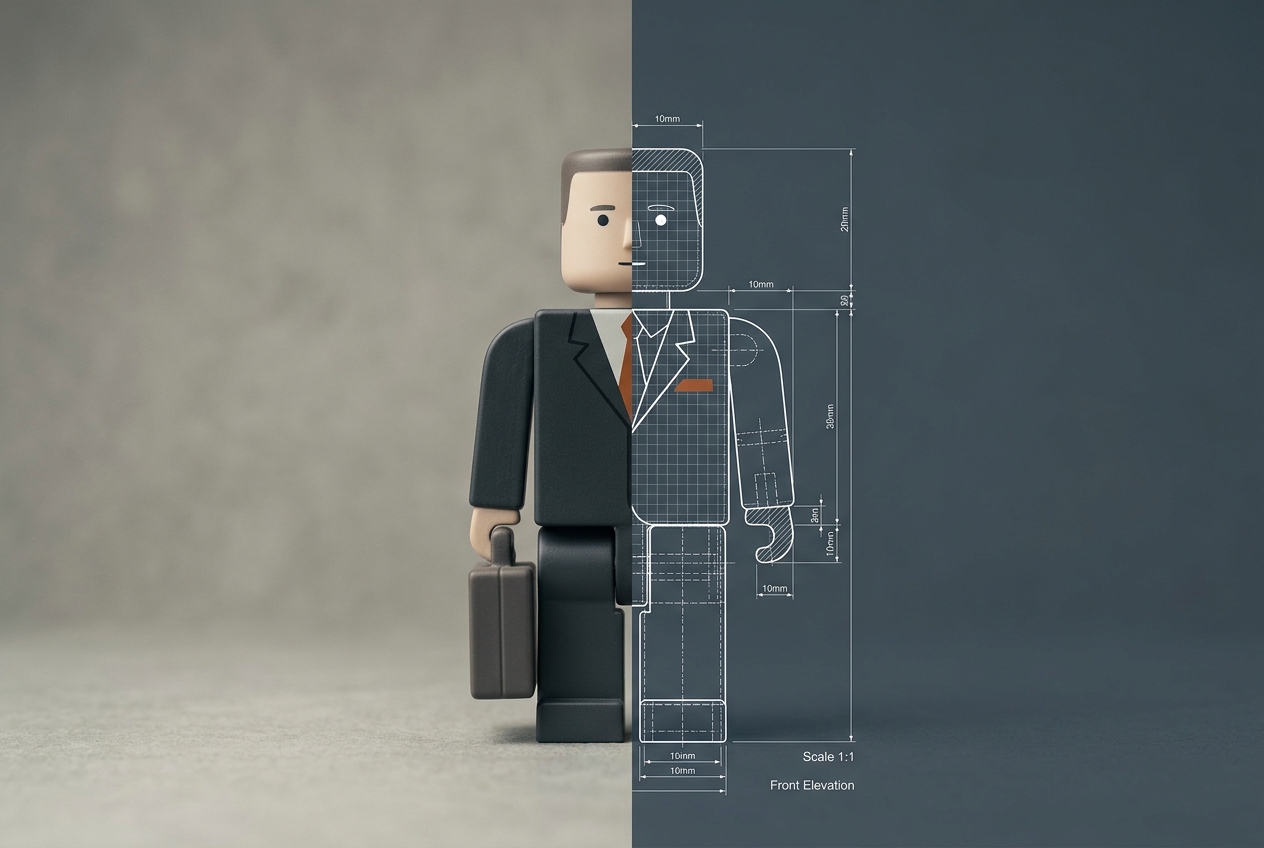
What Are Custom Minifigures — and Why They Are Not Fakes
Customs get dismissed as cheap copies. They are the opposite: original designs that never officially existed. On the stigma, the distinction, and the gap this market grew out of.
Few words divide minifigure collectors as reliably as custom. To some it is the most interesting corner of the hobby; to others it is a synonym for cheap plastic off a marketplace listing. The two groups are not talking about the same thing — and clearing up that misunderstanding is what this piece is for.
The stigma
Say you collect custom minifigures and someone will tell you those are just knock-offs. The prejudice has a real basis. There is a large, highly visible market for recast parts imitating an official figure as cheaply as possible: bundles at prices impossible for genuine parts, print that lifts with a fingernail, clutch power that gives up after two rebuilds.
That market exists. It simply does not describe what collectors mean when they talk about customs — and because both things ended up with the same word, one half of the market gets blamed for the other.
The distinction: three things, three intentions
The fake
A figure in recast plastic sold as if it were genuine LEGO. It wants to be taken for something it is not. Legally a counterfeiting question, in craft terms usually visibly inferior, and worthless to a collector.
The replica
A copy of a figure that officially exists, without pretending to be the original. It creates nothing new, it makes something existing cheaper. Less fraught than the fake, but pointless for a collection: the original is right there.
The custom
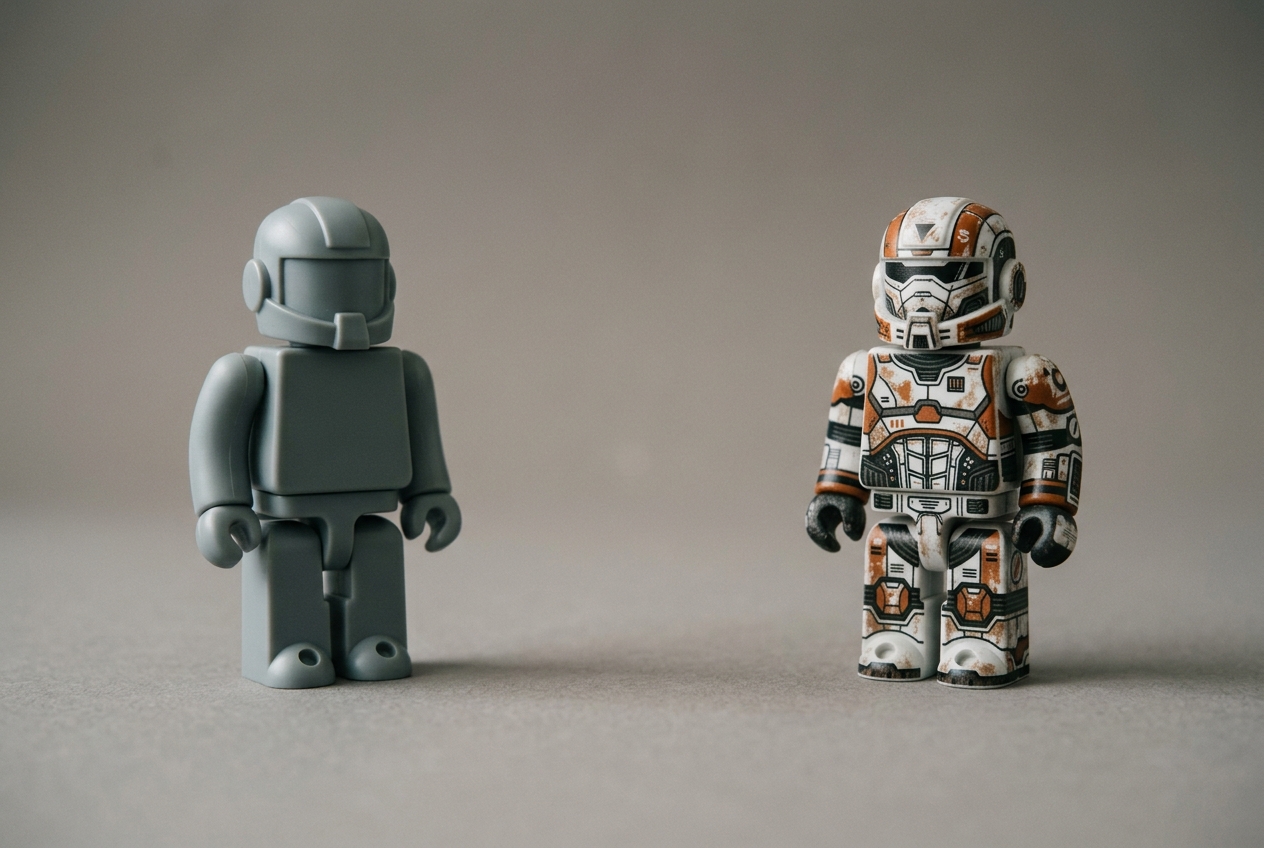
An original design — a figure that never officially existed and in all likelihood never will. A character that was never licensed. A variant that exists in canon but never shipped in a set. Or an idea entirely of the designer's own. At the serious makers, the printing is done on genuine LEGO parts.
The difference is not one of degree but of intent. A fake wants to be mistaken for the original. A custom wants the exact opposite: to be recognisably something that exists nowhere else. Lumping the two together confuses a copy with an addition.
The motivation: why collectors turn to customs
The custom market did not appear from nowhere. It grew where the official manufacturer left a gap — and with Star Wars that gap has been a talking point in collector circles for years.
The observation is always the same: Star Wars figures get the minimum. Unprinted legs, unprinted arms, torsos reused across several waves, helmets without side detail. The effort per figure is visibly capped while set prices keep rising.
That this is not about capability is obvious from the same company elsewhere:
- The Collectible Minifigures Series has shipped dual-moulded legs, arm printing, back printing and exclusive moulded parts for years — in a figure costing a few euros.
- The Lord of the Rings and comparable licensed lines show the same: elaborate leg printing, individual head sculpts, dedicated hair pieces.
- Even inexpensive system lines use details considered too expensive for Star Wars.
So the standard exists. It is simply not applied everywhere. That is the gap custom designers work in, and you can count it: clone troopers of the 442nd, the 332nd and the 327th exist in the custom market and never did officially.
The second motivation is quieter and matters more to many people: completeness. Anyone who wants a unit, a series or a story complete on the shelf eventually hits a figure that was never produced. A custom is then not the cheaper option, it is the only one.
The craft
Dismissing customs wholesale usually means comparing the worst offer on the market with the best official product. The more useful comparison is within the custom market, where the distance between makers is enormous.
What good work looks like:
- Genuine parts as the base. Serious makers print on real LEGO elements. Clutch power, colour and fit stay the ones you know from your own collection.
- Print quality. Pad printing or multi-pass UV printing, solid coverage of light colours on dark parts, detail down to the millimetre.
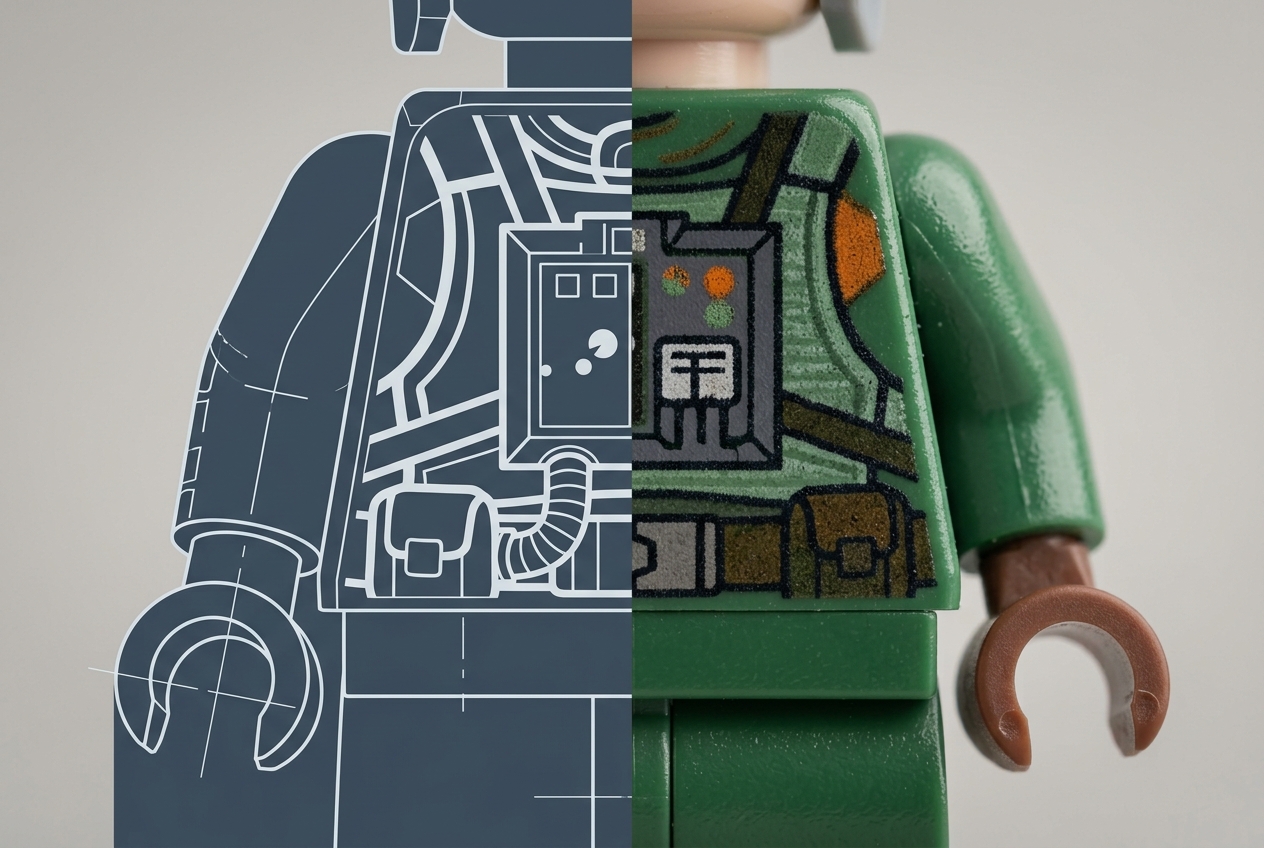
- Detail density. Printed arms, printed leg backs, torso backs, matching accessories — exactly the features whose absence was the problem above.
- Limited runs. Many designs are produced in a fixed quantity and then gone. That explains both the prices and the secondary market.
The full checklist is in Real LEGO minifigure or not?, the price question in What custom minifigures cost.
Who makes these figures
A few names that make the difference concrete — all with complete figure lists in the catalogue:
- Republic Customs — clone troopers and Republic units, consistently in the 2020 helmet style.
- Grandpa Clone Customs — likewise strong on clones, with many variants per design.
- Abnormal — Marvel and DC characters in very small runs, one of the largest catalogues in the scene.
- RichBrick and Jaka Brick — a hand of their own across a wide range of subjects.
- Phoenix Customs, American Brickstore and BricksAndFigs.de complete the picture.
Is this legal?
For you as a buyer: uncritical. For the seller it is more complicated than the scene makes out — the frequently cited exhaustion principle covers reselling goods in unchanged condition, and a figure taken apart and reprinted is changed. On top of that sits copyright in the character depicted. The one risk that reaches you is customs on consignments from outside the EU. In full in Are custom minifigures legal?.
Keeping track
The custom market has a structural disadvantage against the official one: there is no central catalogue. Every shop numbers differently, runs sell out, pages disappear, and what you saw six months ago is not findable again.
That is what Plasticfolk is for — a collection manager that keeps official LEGO minifigures and custom figures in the same catalogue:
- A searchable custom catalogue. Every indexed maker figure carries a stable ID in the same shape as a BrickLink number, variants included — long after the shop delisted it.
- Value and price history. Purchase price, market value and development per figure and across the whole collection.
- The scanner. Capture figures and collectible minifigure boxes with your phone camera instead of typing them in.
- Public collection pages. Publish a selection at an address of your own and share it — opted in per list, everything else stays private.
Start a collection — or browse the catalogue first.