Why There Are No LEGO Star Wars Collectible Minifigures
Marvel has two CMF series, Star Wars not a single one. The reason sits in LEGO's licence contract — and it explains why individual Star Wars figures exist anyway, just almost never for sale.
Collectible Minifigures have existed since 2010. There are LEGO's own series, licences such as Looney Tunes and the Muppets, and since 2021 Marvel as well. But the licence LEGO started its first theme with other people's characters with in 1999 is still missing: there has never been a Star Wars series.
Among fans the answer is usually just "Hasbro said no". That is true, but only half the story. The other half explains why hundreds of individual Star Wars figures exist anyway, and why almost all of them were given away.
A contract for bricks
The split goes back to the late 1990s. Hasbro had taken over Kenner, the first Star Wars toy maker, in the early nineties, and for Episode I it received the rights to action figures, vehicles and playsets. At almost the same time Lucasfilm was looking for a partner for construction toys. How long LEGO argued internally about that offer is told at length by The Cosmonaut in his video. The first sets reached shops in 1999.
Ever since, the rule has been: Hasbro makes action figures, LEGO makes everything you build. Nothing about that has changed. Michael Lee Stockwell, Design Manager for LEGO Star Wars, told Brick Fanatics in 2021 that the contract with Lucasfilm and Disney covers construction toys. Minifigures may come in sets because they are part of the play there. LEGO does not have a licence for action figures.
So the border between the two worlds is the minifigure itself. It has arms, legs and a head that turns, which means movable joints like an action figure. Inside a set it is an accessory to the build. On its own in a bag it is Hasbro's territory.
The one attempt: figure packs in 2000
LEGO did try once. In 2000 it released four Minifig Packs, each with three figures and display stands, for 5 dollars:
- 3340 Emperor Palpatine, Darth Maul and Darth Vader
- 3341 Luke Skywalker, Han Solo and Boba Fett
- 3342 Chewbacca and two Biker Scouts
- 3343 Battle Droid Commander and two Battle Droids
After a year the packs were gone, and no successor followed. There is no official reason. The explanation collectors pass around is that Hasbro complained to Lucasfilm. It appears in the comments on Brickset and in The Cosmonaut's video, who says himself that he cannot prove it. What can be shown is what came next: from 2002 even the smallest Star Wars boxes had something to build, such as the Final Duel and Jedi Defense sets with two or three figures and a small scene.
Detours with a build
Since then LEGO has worked along the edge of the contract. Two detours cost money, and that is exactly why they work.
Battle packs bundle four figures with a small speeder or turret at a low price. Jens Kronvold Frederiksen, Design Director at LEGO, calls them, in the same conversation with Brick Fanatics, the way for collectors who want to build an army. In his words, the build is in there for contractual reasons too.
Magnets arrived in 2006: Star Wars minifigures as fridge magnets, barely altered at first, later glued firmly onto a magnetic brick. For Frederiksen they are merchandise, not toys. That distinction carries the rest of this story.
Figures you can only get as a gift
One route needs no build at all: the gift. Individual Star Wars figures have existed for decades, just hardly ever for money.
In the magazine. The LEGO Star Wars Magazine is published in the UK by Immediate Media and in Germany by the Stuttgart publisher Blue Ocean Entertainment, which has worked with LEGO since March 2013. Almost every issue comes with a bag holding a minifigure or a small model. The figures are rarely new, but often hard to get: the Emperor Palpatine from issue 69 (2021) was otherwise only in the far more expensive set 75291, and the 501st Legion clone trooper from issue 86 had previously come only in the battle pack of the same name. 2026 was a particularly figure-heavy year; towards the end of it the magazine is turning back to small models.
For collectors in Europe the magazine is a stroke of luck; for everyone else, less so. It is only readily available in the UK and a handful of European countries. Collectors in the US, Canada or Australia have to import the bag or buy it second-hand. On the newsstand the magazine still pushes prices down: Luke in his Bespin outfit could only be had in the expensive Betrayal at Cloud City set until 2020. Since he came with the magazine he costs a few pounds, while the other figures from that set cost many times as much.
Over the years this turns around. Whatever is no longer on the newsstand becomes scarce, and the oldest bags are now worth far more than the magazine they came with. An issue costs 6 to 8 euros depending on the title. According to Plasticfolk market values, the sealed Slave I from 2015 now sits at around €33, Kanan Jarrus from 2017 at around €24 and the Imperial Combat Driver from the same year at around €17. Bags from 2020 onwards are mostly still between €7 and €11, roughly the cover price.
At trade fairs. At the Nuremberg toy fair in 2005, visitors to the LEGO stand received a light-up Darth Vader, timed for Episode III.
As a gift with purchase. Most rarities came free with a purchase, a gift with purchase or GWP in collector speak:
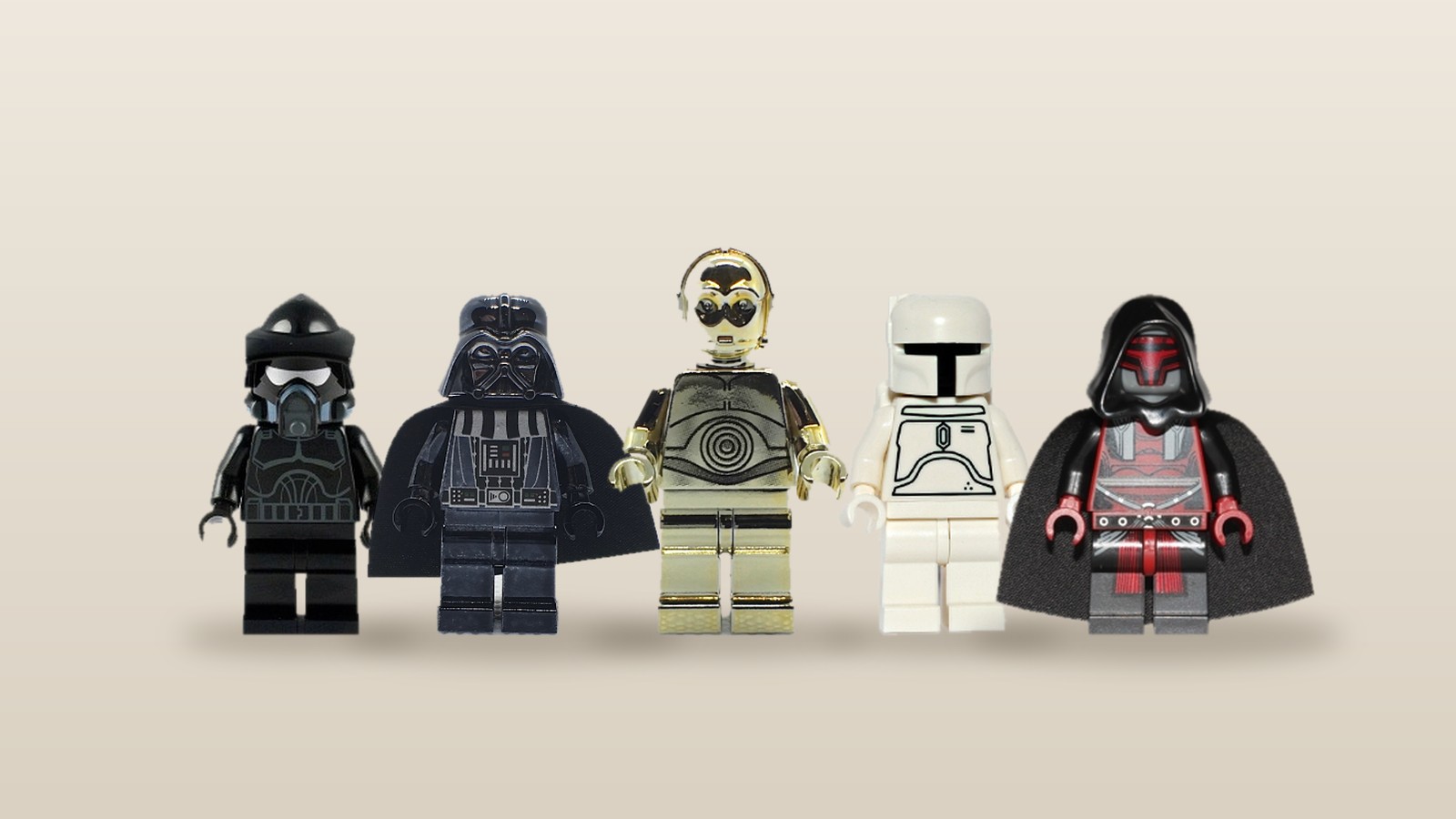
- Gold C-3PO, 2007: For the 30th anniversary of Star Wars, 10,000 were inserted at random into sets.
- Chrome Vader, 2009: For the 10th birthday of LEGO Star Wars, another 10,000 went into sets in the US and Europe.
- White Boba Fett, 2010: For the 30th anniversary of The Empire Strikes Back; in the UK, for example, at Smyths with a spend of £30.
- Shadow ARF Trooper, 2011: Free with Star Wars orders in the LEGO online shop in May.
- Darth Revan, 2014: The same promotion, repeated in September 2016.
Why give them away instead of selling them?
That LEGO gives away so many figures but sells almost none has three reasons, and they interlock.
The contract is about selling. What LEGO may not do is develop and offer action figures. A gift with purchase, on the other hand, is advertising for a set, and with the magazine a licensed publisher sells a magazine that the figure comes with. That is how The Cosmonaut reads it, and it fits Frederiksen's line between merchandise and toys. LEGO has never confirmed that reading for the free figures, though.
The figure sells the set. A gift with purchase is a threshold: the white Boba Fett came only with a £30 spend at Smyths, the Shadow ARF Trooper only with qualifying orders. The figure gets the customer to spend more. Sold for five euros on the shelf, it would replace a set purchase instead of triggering one.
Scarcity creates value. Whatever was only around for a few weeks is sought after. According to Plasticfolk market values, the Shadow ARF Trooper now sits at around €400, Darth Revan at around €300, the chrome Vader at around €510 and the gold C-3PO at around €2,050. Several of these giveaways also appear in our list of the most expensive Star Wars minifigures.
The cross-check: Marvel
Marvel shows that "Hasbro said no" falls short. Hasbro also holds the action figure licence for Marvel and extended it in April 2025 together with Star Wars. Even so, there are two Marvel Studios series, 71031 from 2021 and 71039 from 2023.
Scarlet Witch from the first Marvel Studios series
So what matters is not only what Hasbro may do, but what LEGO's own contract with each rights holder says. With Marvel, according to 9to5Toys, Hasbro's exclusivity for figures ended at the start of 2021, and LEGO used the gap straight away. With Star Wars the wording apparently stayed. How the Marvel figures compare in value with other series is shown in the list of the most expensive Collectible Minifigures.
Will the series ever come?
Not any time soon, by the look of it. LEGO's Star Wars licence was extended in 2022 and is said to run until at least 2032. According to the Holo-Brick Archives, nothing changed about the action figure rule. On the other side, Hasbro's 2025 extension explicitly promises to keep bringing the galaxy's characters to life as action figures. Brick Fanatics suspects that this very wording rules LEGO out, but calls it speculation itself.
There is also the opposite view. In "The TRUTH About LEGO Star Wars Minifigures!" on 7 May 2021, MandRproductions accused LEGO of having been allowed to sell individual figures all along and simply not wanting to, because the figures earn more inside expensive sets. Three weeks later LEGO contradicted that with Stockwell's and Frederiksen's statements. The Cosmonaut ends up at the end of his video between the two: the contract forbids it, but LEGO also has little reason to fight that clause.
What collectors make of it
The closest thing to a Star Wars series is still the four packs from 2000. For an army there is no way around the battle packs. Anyone after a single figure should check the magazine before buying the whole set – on the newsstand in Europe, elsewhere mostly second-hand. Anyone with old issues still sealed in a drawer should not tear the bags open carelessly. Rarities are found among the gifts.
With figures spread across so many routes, it is easy to lose track. Plasticfolk helps:
- Where a figure comes from: Every figure shows which sets it came in, including promotional packs and magazine bags. So you can see whether the clone trooper you are after is cheaper with the magazine.
- What is missing: Missing figures go on the wishlist with a star.
- What the collection is worth: Plasticfolk works with purchase price, current market value and the trend, per figure and for everything together.
Sources: The Cosmonaut, "Why Lego Can't Make Star Wars Collectable Minifigures" (YouTube, 2026); MandRproductions, "The TRUTH About LEGO Star Wars Minifigures!" (YouTube, 2021); Brick Fanatics, "LEGO responds to rumours over Star Wars minifigure licensing rights" (2021), "LEGO's new Star Wars licence rumoured to exclude Collectible Minifigures" (2022), "Five rare minifigures included with LEGO Star Wars Magazine" (2022), "LEGO is killing the Star Wars minifigure aftermarket with its magazines" (2023), "LEGO Star Wars CMF series is likely still not on the cards anytime soon" (2025) and "LEGO Star Wars magazine is moving away from minifigures again" (2026); mobiFlip, "LEGO Magazine vom Blue Ocean-Verlag" (2024); Hasbro, press release of 24 April 2025; Brickset, Minifig Packs, Star Wars magnets and the linked promotional sets. Cover: collage of catalogue images from BrickLink.
Market values in euros, new (magazine bags sealed), as of 17 November 2026. Based on sales prices on BrickLink, averaged over the last six months.
Last edited on Nov 23, 2026